Wednesday, May 6, 2020

FlipStik v.1 - Part 1

FlipStik v.1 - Part One 


A fairly easy to make hangbar that has some unique properties. This blog post probably won't answer every question that one might have, but hopefully will give enough info re the design and building process that the average woodworker can make their own custom version of it.

GOAL - create a hang bar project that:
  1. takes up minimal space - both when mounted and when stored
  2. rigidly mounted (vs hanging/suspended types of bars)
  3. aesthetically pleasing
  4. functional
  5. doorway mounted on expandable pull-up bar (see discussion in Part 2)
  6. can be left up and not interfere with the function of the door or can be easily removed and stored behind the door
  7. is 'universal' in that it isn't dependent upon doorway size
  8. mounts as high as possible for a doorway type pull-up bar
PARTS NEEDED:

The bar is created out of three pieces of wood obtained at my local Lowes.com. It could also be routed or CNC machined out of a single piece of 1.5” x 3.75” x 36” piece of poplar (or other hardwood) if you have the tools and know-how.

2 pcs- 1.5” x 36” square hardwood pcs
1 pcs - .75” x 1.5 x 36” hardwood piece
2 pcs - 1/2" x 3-14" x 4-1/4" hardwood plywood for J-hook backing/spacer plate (or 1 pcs 1/2" x 3-1/4" x 30" (see discussion in Part 2)
3 - 3” #10 wood screws
backing plate screws
     1-3/4” wood screws
     1-1/4” wood screws
closed cell foam padding: 1/8”-1/4” depending upon doorway and doorway trim profile (craftstore foam)
expandable doorway pull-up bar (ones with end-cups is recommended if you are heavier than 150 lb)

TOOLS USED: can be created with a wide variety of tools from simple hand tools to router and jig. Tools I used in the project: drill press, router table and various router bits, belt sander, hand sand stick

DESIGN: 
  • based on my LipStik design without the folding legs - BUT - it is flippable which gives twice as many edges (8 instead of 4) for the same number of pockets/steps and space (it’s a whole other discussion whether more edges are necessary or better for effective training)
  • It is designed to be mounted on expandable doorway pull-up bar. Bar can be left up and door is still functional. 
  • 3-piece design that allows working on individual pieces before being assembled
  • uses a “stepped finger stop" design that allows user to easily customize for their particular needs

MAJOR STEPS IN MAKING THE FLIPSTIK


1) cut boards to correct dimensions (I was able to buy the correct dimensioned boards at Lowes.com)


2) layout and cut the “steps” in the center board


3) layout cut lines and remove the cutaway on bottom board 


4) put radius on pocket edges of both top and bottom rails (easier to do this before assembled (see discussion below)


5) glue/clamp/screw the three boards together (no photo)


6) radius the top top rail to 1.5”  diameter for warm-up/pull-up bar.


7) round front edge of bottom rail


8) monos - if desired - drill  3/4” hole 30mm deep (or 13/16” - 7/8” depending upon how fat your fingers are and how much side support you want for your fingers). Generously chamfer the edge of mono. Notice the screws holding the three pieces together when I glued it that didn't show up in the other photos.


~~~~~~~~~~~~~~~~~~~~~~~~~~~~~

See Part 2 for finishing the bar including mounting the J-hooks, what pull-up bar is best, and other finishing details.
See Part 3 for a suggested French cleat version of this bar.

~~~~~~~~~~~~~~~~~~~~~~~~~~~~~

NOTES AND DISCUSSION

Edge radius discussion - some boards have a constant edge radius no matter size the edge depth (Eva Perez’s Transgression and Progression boards). While others, use a progressive edge radius (the larger the edge, the larger the edge radius) that generally yields more comfort but less accuracy when comparing edge sizes across boards. In this board I've used progressive radius using round-over router bits - which needs to be done before the board is assembled. If I were to do it over again, I'd use one constant radius for the top rail, and a smaller radius one for the bottom rails (smaller edges)

How many edges/pockets on a hangboard? Edge depths: often the general consensus is the more edges/pockets the better but it depends upon your preference in relation to how you train and your general finger fitness.  I think training can be done effectively with as little as three. However for some training protocols it is helpful to have more edges.

Pockets vs non-pockets: true pockets are unnecessary in my opinion. Just limit the number of fingers on any particular edge to achieve the same thing. Sides of pockets just help you "cheat" and take up space. I find it mildly humorous to see all the different pockets on some commercial boards. The one exception might be the mono. It can put a lot of stress on the single finger/joint on a normal edge -especially when first starting to train monos. So it can be important to provide as much support as possible through the sidewalls of a mono if you intend to train monos..

Flippable vs non-flippable: this same basic design could be used in a non-flippable board (like my LipStik) that would have only 4 edge sizes and could be permanently mounted above a doorway resting on the doorway trim with several screws into studs, OR, if using a pull-up bar,  just use one set of J-hooks.

Asymmetrical vs symmetrical edge spacing: Many hang boards in the past were symmetrical - that is - have the same edge spacing mirrored from the center line of the board. However that causes unnatural hand spacing in relation to your shoulders - from scrunched to uncomfortably wide. More functional and comfortable in my option is the asymmetrical spacing that allows constant spacing between the hands and shoulders. This bar is designed to have a constant spacing of 18”.

The following are some suggested alternative edge sequences. This is the versatility of using a method like this for creating a hang bar.

Bar shown above is a super wide ratio bar for beginning climbers to moderately advanced climbers 
[12mm top/bottom rail difference with 3mm steps]  
normal: 30 / 27 / 24 / 21
flipped: 18 / 15 / 12 /  9   

general wide ratio for beginning to hard-core
[10mm top/bottom rail difference with 2.5mm steps] 
normal: 25 / 22.5 / 20 / 17.5
flipped: 15 / 12.5 / 10 / 7.5  

beginning to moderate climbers (this is the same as Eva Perez’s Progression board)
[8mm top/bottom rail difference. 2mm steps] 
normal: 24 / 22 / 20 / 18
flipped: 16 / 14 / 12 / 10     

moderate to hard-core climbers, close ratio
[8mm top/bottom rail difference. 2mm steps]
normal: 20 / 18 / 16 / 14
flipped: 12 / 10 / 8 / 6      

FlipStik v.1 - Part 2


The FlipStik is based on a standard expandable doorway pull-up bar. They can be had from $19-$60.

Caution: this whole system depends upon your doorway framing being solid. If your doorway does not have structural integrity, then it would probably be better to not use this method of mounting but adapt it to the other major type of doorway pull-up bar where it hangs on the trip lip and then cams against the front of the doorway. I have not adapted this bar yet for that type of pull-up bar so you are on your own...

The main thing is that if you way over 140 lb, I'd recommend getting one that comes with steel cups that can be screwed into the doorway and help hold the bar in place. This makes it more secure. Mine is rated to 300 lb. if mounted with the steel cups. I didn't use them because I weigh 130 lb. and the doorway is strong enough that I could just expand the bar into place and it was enough. The disadvantage of using the steel cups on the ends to hold the bar is that there will be 3-4 small screw holes on either side that you'll have to fill if you want to permanently take it down.

Bar without mounting cups


Steps for adding the pull-up bar mounts

1)  Cut J-hook backing plates out of 1/2" ply or 1/2" poplar stock

2)  glue and screw on backing plate(s) for hooks on back of bar

3)  screw on hooks - I spaced the hooks so they would be on the outer smaller diameter part of the bar and space the hooks about 1/2" a part to give more strength to the screws in the wood. You'll need to use a shorter screw than the ones that come with it for the circled location. The board is thinner at that location because of the "cut" on the other side of that board.

4)  add doorway padding and adjust for doorway/bar fit. You want bar to lie flat again the molding and not tilt out or in.


Wednesday, November 1, 2017

The SqueezeBox - An Adjustable Crack Hangboard


The following project gives the basic steps I used in creating the Squeeze Box, an adjustable crack hangboard. Here are some of it's features:
  1. adjustable up to OW (hand-fist stack)
  2. hangs from one or two suspension points
  3. option of mounting a hangboard or holds on the two outside surfaces
  4. can be hung vertical or horizontal
  5. adjustable for parallel, incut or flared crack
  6. angle of board can be adjusted to make crack/holds easier or harder.
  7. fairly reasonable cost to build
The board is based on a set of Jorgensen #1 wood clamps that I obtained on Ebay. I think I paid around $16 for the set. Since I wanted the board width to be 8", the ends of the clamps were cut off. For my hands 8" is plenty wide, though they could be left full size.


In order to get the clamps apart (normally they are designed so they can't be disassembled), approximately 3/8"-1/2" is cut off the end of one of the threaded rods of each clamp. This allows the clamps to be disassembled when fully unscrewed. The clamps need to be disassembled in order to attach to the wood plates.


For the wood plates I used two layers of 3/4" plywood glued and screwed together. This also allows T-nuts to be added should you desire to use bolt-on holds. Overall dimensions the plates are 8" x 25". The width should be adjusted to fit the hangboard, if you plan on attaching one. I would suggest the ideal size could range between 24"-27". One half of each plate is 3" shorter to make a lap joint where the wood clamps are attached.  Notice the holes drilled for the wood clamp threaded rods to pass through. (Note: 2 x 10 pine lumber [1 1/2" x 9 1/4" actual size] could be used instead of plywood, however you'd need a table saw and dado blade to cut the lap joint notches on the end of the plates.)


The two halves of peach plate are then screwed and glued together, making sure that the screws are screwed from the outside so the inside surfaces of the crack remain smooth. Shown below are both finished plates (one of the plates has the Continuum Board attached (discussed in a prior blog post).


This shows the wooden clamps attached with glue and two large wood screws.


Clamps reassembled to form the basic Squeeze Box frame. Notice also the bottom inside edges of the crack were rounded for comfort


A 10' strap from Strampworks.com was used to provide the sling. The strap was cut as shown below and ends were doubled and a screw hole burned through both layers with a hot nail. They were then attached with 1 1/2" long wood screws with heavy 1" washers. The angle of hangboard is adjusted by changing the hang loop length on the quick-release buckle side.


Finished Squeeze Box hangboard. It can be hung from one or two points. For a Horizontal mount, two suspension points provides more stability. For vertical orientation, it is hung from a single suspension point.


Note: The inside crack surface was left as natural wood. Texture could be added via fine grit sandpaper or a textured paint. However, caution should be used as if intensive training is done on it, hands could easily be abraded. I've chosen to use it with tape or crack gloves.

Saturday, February 4, 2017

6GRIPS: The Simplest, Most Versatile Training Grips You've Never Seen


When I started up SICgrips one of my main observations was that most hangboards and training grips devoted an inordinate amount of space for edges/pockets/crimps. Whether a pocket, a 1-2 joint edge, or crimp, they are all basically the same grip/hand position. This is fine if you mainly do face climbs with edges, but it leaves out many other grip positions that most climbers encounter.  If one were to just use one edge that could serve multiple uses, then the grips could include other hand positions and would provide a more balanced and functional training tool. In addition if you are able to adjust them around all three axis (vertical, horizontal and rotational), you would have a super versatile set of training grips that are easy on the joints. This is one of the main design principles behind our Gstring PROs and Pocket Rock training grips.

6GRIPS offer the following grip positions:

  1. half-hand sloper (4.5" diameter)
  2. wide pinch 
  3. medium pinch
  4. large rounded jug
  5. flat or sloping edge (half-hand, 2nd joint, or first joint)/variable depth crimp
  6. variable difficulty round/sloper crimp
Grips can also be lowered and used for suspended push-ups or dips/press-ups.


While they are not as sexy as our Gstring PROs or Pocket Rocks, these grips are simple, versatile, cheap to make, compact, and lightweight (18 oz.), If all the materials are gathered ahead of time, they could be made in an afternoon and, depending upon materials that you may already have, they can be made for as little as $10. However, if you have to go out and buy everything, they'll cost considerably more, though you'll end up with materials to make at least two  or more sets because of the minimum quantity most hardware stores sell.

We have strayed somewhat from one of our guiding principles in our last two DYI projects: Continuum Board and gBar. However this current project is a return to our roots and offers the DIYer a very simple and versatile set of grips with minimal cost, time and number of tools.

Materials:


  • 1/2" x 6" x 4.5" piece of poplar plank for hardwood plywood
  • 6" piece of 4" dia. PVC (2' is usually the minimum quantity you can buy)
  • 3/4" half-round x 6" x 2 pieces hardwood (oak or poplar - hardware stores frequently sell this as trim and is sold in 8 foot lengths)
  • 5mm x 10' accessory cord
  • 2 sheets of 320 grit sheet sandpaper or a roll of 4.5" wide PDA (pressure sensitive adhesive) sandpaper
  • contact cement if not using PSA sandpaper
  • 24 - #4 1" wood screws
  • epoxy

Tools:

  • drill
  • hand saw (I used a Japanese pull saw but a table saw is even better if you have access to one)
  • screw driver

Assembly Notes:

The grips shown are 6" wide - you can modify the width to suite the size of your hands.

4.5" wide PSA (pressure sensitive adhesive 320 sandpaper is what I used. You could also use sheet sandpaper and contact cement. With sheet sandpaper, it could go the whole width of the grip, however the cord will rub on it and wear faster. Update: I've actually ended up removing the sandpaper. I like it better without. I've roughed up the wood and PVC with 80 grit sandpaper, then used a rosin bag along with chalk to increase friction. Very easy on skin!

4 wood screws were used to hold the PVC to the 1/2" wood. I used epoxy with rubber bands to hold in place and once it was set a bit (5 minutes) I drilled the holes and put the screws in. Make sure to counter sink the hole so that the screw heads will fit flush.

If cutting the 1/2" wood on a table saw, use a 5 deg. blade tilt to help match it to the inside diameter of the PVC pipe. Otherwise if you use a hand saw, slightly sand the edges to match the curve on the inside diameter of the PVC.

Three wood screws were used to hold the 1/2 round to the grip and they were put in at an angle. This was done so they didn't come through the 1/2" wood and to make sure the screw head were away from the primary surface where the fingers would be contacting it.

Round, the edge of the PVC on the side away from the crimp to a radius that feels comfortable to your fingers. For me this was somewhere around a 1/4"r to 5/16"r.

If using standard 5mm accessory cord to string it, drill 3/16" holes on the side of the grip for the knots. On the other side of the grip where the cord will slide through for adjustment, drill 1/4" or 5/16" holds so that the cord will fit through easier and will make moving grip positions easier.


Additional Notes:

  • Precise control over the width of the flat edge crimp is obtained by cutting two extra pieces of the 3/4" half-round, each 1/2" wider than the width of your grip to create an adjustable finger stop.  They can be adjusted setting to pencil lines at 1/8"intervals. Use a rubber band around the ends to hold in place and slide to the desired crimp depth. When not in use they can either be removed or stored out of the way on the inside of the grip.
  • optional girth or prusik loop for doorway use while traveling. See our Pocket Rocks page for more info.
  • For a way to easily reset the grips back to a previous position/angle, use marks or dental floss as shown here.
  • If you desire to have a bar instead of individual grips, you can create one 18" long grip. This means you'd only have to adjust the cords once instead of for each individual grip and it's also a bit simpler to make. However the disadvantage is that it will weight about 40% more and you will not be able to rotate the grips around the vertical axis for comfort. If you have elbow issues using individual grips will allow you to find a more comfortable angle and put less stress on your elbows.
  • To train a specific grip type, drill a hole and mount a T-nut in the center of each grip. This gives the option of mounting a small-medium size wall hold. It's easiest to add the T-nut before the PVC and wood are screwed together, though it can still be added after they are finished.
  • It's possible to make Simple Grips with the RipCord easy adjustment system of the Gstring PROs. However this will increase their cost; they will hang 3 inches lower; weigh 8 oz. more; and it will increase the complexity of making them. If interested, see this blog post for the basics of how to do this. 

Using

  • mount or hang the same has for our Pocket Rocks or Gstrings
  • Different sets of grip positions are accessed by either sliding cord to change the relative size of each loop, or by flipping cords to the other side of the grips (see the first photo at top of blog).
  • Reverse your hand hand positions (palms facing you) to train for underclings
These grips offer most everything a normal hangboard, hangbar, or commercial training grips offer.   About the only thing they don't cover are cracks which no commercial hangboard yet covers. We still hope to produce our prototype Crack Rack as a commercial product and our next two DYI projects (the SqueezeBox and GrooveTube) will offer crack training. Stay tuned.


Monday, January 30, 2017

gBar: A Do-It-Yourself Hang-Bar - Part 3

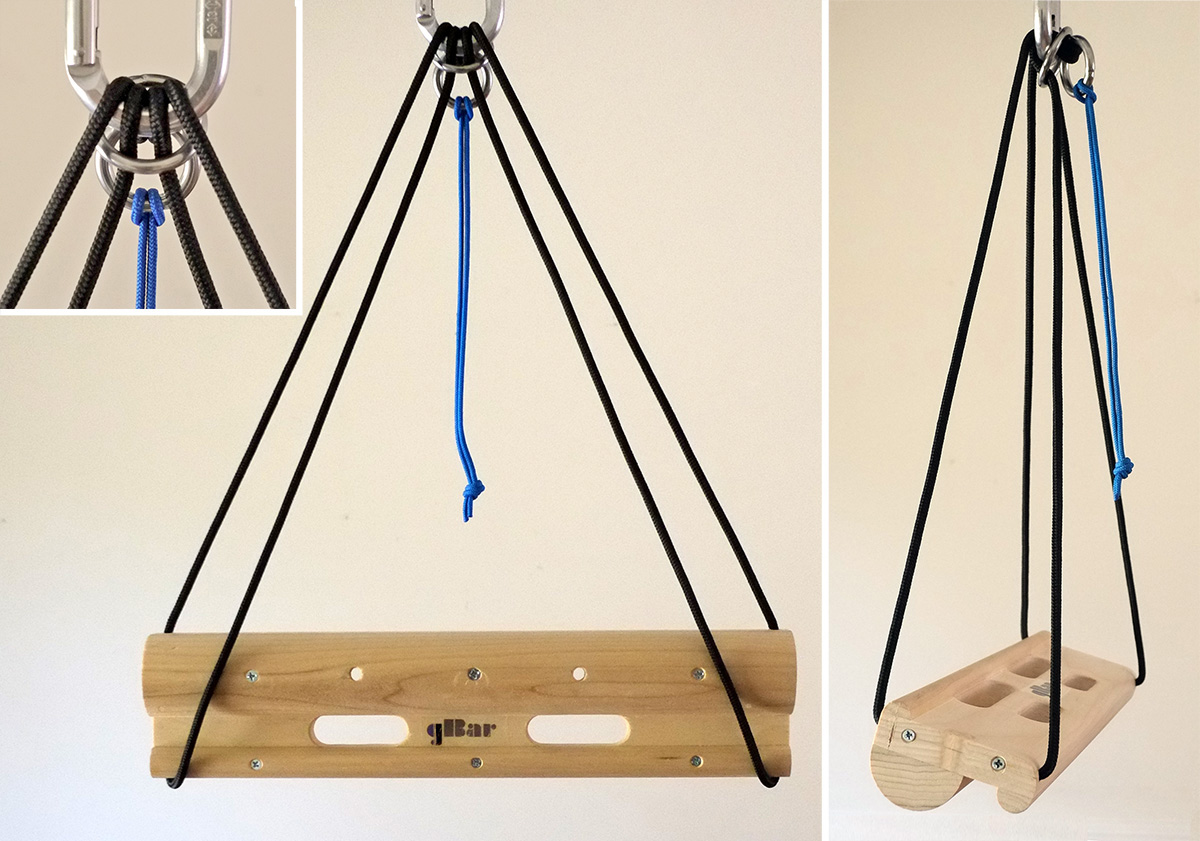
I'm finally getting around to finishing up the series on making the gBar. Hopefully if you've actually constructed one you've figured out a sling system to hang and be able to adjust it. However I'll finish out the series showing two methods for how I've done it. I'm sure there are other ways also. The sling loops needs to be adjustable and they need to be able to be flipped to the other side in order access all the grip positions that the bar is capable of. Note: both these methods are slightly different than the original photos posted.

The first slinging method is fairly simple but not quite as aesthetic and functionally not quite as good. In this method, you'll drill four holes through the bar as shown below. On one side the holes are 5/16" and on the other 3/16". The reason for this is to make the adjustment a bit easier on the side with the larger holes, while helping to secure the cord on the side with the knots so the cord doesn't slide around. The knots should be tied on the side with the smaller holes.


The second method, though a bit more complex, ends up being a bit nicer in appearance because there are no external knots and it's a bit easier to adjust because of the cord path. The 5/16" holes on one end are drilled as shown and consist of two holes drilled so that the cord path makes approximately a  45 deg. bend. The 3/16" holes are drilled on the other end. Then perpendicular to the cord path two countersunk 1/16" holes for 1" #6 wood screws. Instead of the knots securing the end, the ends are inserted into their respective holed and then secured with the wood screws giving a nice clean finish.


It's possible to use 6mm cord instead of 5mm but all holes will need to be increased slightly in size.

When using the gBar the different grip types are accessed by changing the relative size of the hang loops by sliding the cord though the bar on the side where it it free to slide. Also for some of the grip positions you'll need to flip the cords to the other side of the bar.

Here's a summary of the grips available on the gBar the position/angle the bar needs to be adjust to:


Any of the grip positions can be made harder or easier by adjusting the sling slightly to change the hang angle.

Update

The gBar can also be made with the RipCord quick release adjustment system used by the Gstring PROs. This would allow you to quickly adjust the angle of the bar/type of grip without having to remove the bar from its mount.

You will need 2 x 3 feet pieces of 5mm accessory cord. More if you want it to hang lower. Use the screw method for securing the ends of the cord as described above. For the rest of the instructions, follow steps #8-19 from our previous post on the Quick Release system. Thread both rings onto both cords together instead of crossing them as described.

The result should end up looking like this:


To access all the grips positions, for some you will need to flips the bottom cords around the ends while it is hanging.

Update #2

I am now experimenting with making them as follows. It includes all the grip positions of the original but makes the three-finger pockets into two-finger pockets (duos) and adds monos. The monos are drilled 1.5" deep and since it's positioned to take advantage of the 5/8" rounded crimper, it gives it a "comfort" edge and increase the depth slightly. The bar is now a full 18" wide compared to the shorter 15" bar above. Notice the slight change in position of the top cord holes to make it slightly more functional.


This same layout could be further modified by adding a one-arm mono and one-arm duo in the center of the board if you're strong enough to train train them. That's above my "pay grade" so I'll leave it to you beasts out there to add those.

If you have any questions, feel free to ask.

The next do-it-yourself project will be a set of grips that are super simple and cheap to make out of plywood and PVC pipe.

Sunday, November 27, 2016

gBar: A Do-It-Yourself Hang-Bar - Part 2

Materials: I used poplar wood throughout obtained at a local hardware store. 3/4" birch plywood could be used instead of the solid 3/4" poplar plank.

Note: the width of the finger slots/holes/pockets are all 3/4". If you have large fingers, you may want to increase their size to 7/8" or 1" to fit your fingers. If you use a larger size , make sure you increase the overall width of the board accordingly.

Dowels were bought from local hardware store and cut in half. To do this you need a table or band saw. It's also possible cut the 2" dia. dowel in half with a hand saw but that would be tricky. Here is a link to a simple jig that can be used to safely cut the dowels in half length-wise on a table saw. A Google search will yield other jigs for use with a bandsaw.

If you don't have access to a table or band saw it's possible to buy half-rounds from various wood suppliers. The 3/4" half-rounds can often be obtain in the molding/trim section of a large hardware store.

All dimensions for constructing the gBar are listed (or can be inferred from) on the dimensioned drawing in the previous post.

Here is the step-by-step process:
  1. Cut the 3/4" x 3.5" x 18" base board of the bar
  2. Cut the three dowels to 18" in length then slice/cut in half
  3. Round one edge of the base board to 1/2" radius. I used a router for this but could be done easily by hand with a file/rasp/plane/ or sandpaper.


  4. Layout with pencil on the board where the finger slots and dowels will go making sure that the rounded edge (of step #3 above) is on the opposite side of where the 3/4" half-round dowel will go.
  5. Cut the finger slots: I used a drill press to cut these holes by using a fence and repeatedly drilling a series of holes until the desired length of each finger slot is obtained. This is slow and tedious but if done carefully can yield good finger slot. You could also use a plunge router which be easier and give a nicely finished slot. If you don't have a router or drill press, you could use a hand drill to drill a 3/4" hole at each end of each finger slot. Then use a reciprocating saw or hand coping saw to cut out the material between the holes.
  6. Radius the bottom edge of the finger slots that will be on the back side of the board. I used a 1/4" radius router bit but this can easily be done by hand. The goal is to get a radius that will be comfortable on your fingers when hanging. The top part of the finger pocket will be be radiused by the 5/8" dowel


  7. Attach the 2" half-round dowel to the base board. Use 3 #6 1-1/2" wood screws and wood glue. I used wood clamps to hold in position while I pre-drilled slightly smaller holes for the wood screws. If you measured and cut correctly, the edge of the 2" half-round should line up with the edge of the finger slot and the edge of the board.


  8. Do the same with the 3/4" half round dowel except use 3 - #6 x 1" wood screws. This should line up with the other edge of the finger slot and the other edge of the board.
  9. Attach the 5/8" half-round on the back side of the board. I did this with the 6 - 3d 1-1/4" finish nails and glue.
  10. This photo show optional holes drilled in the finger pockets to increase the depth for monos by 1/2"-3/4" more. It also shows optional 1/4" hole drilled in the middle of the finger pocket to help facilitate pushing the shims out from the other side if they are used.


  11. Shims can easily be made by trimming 3/4" craft sticks/tongue depressors with scissors and then smoothing with sandpaper. In use, this allows you to increase the difficultly by 1mm at a time. They can also be created with non-corrogated cardboard. Layers can be glued together to make the thickness desired or they can be used with double-sided cellophane tape to adjust on the fly...or if they are trimmed carefully they can have a press fit and then pushed from the other side via the optional access holes shown above.


    All packed and ready to go in my carry-on...


Next blog I'll cover two different ways to sling and adjust the bar.